Strayed Horses and Land Transactions: Unraveling the Web of the Stewarts, Blantons, and Randolphs
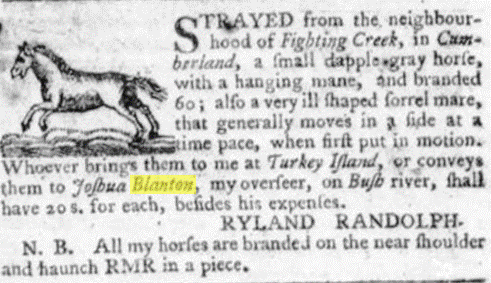
On July 25, 1766, an advertisement in the Williamsburg VA Gazette announced two missing horses, but beneath this simple notice lies a complex web of connections involving land transactions, family ties, and local affiliations between the Stewart, Blanton, and Randolph families:
“Strayed from the neighbourhood of Fighting Creek, in Cumberland, a small dapple gray horse, with a hanging mane, and branded 60; also a very ill-shaped sorrel mare, that generally moves in a side at a time pace, when first put in motion. Whoever brings them to me at Turkey Island, or conveys them to Joshua Blanton, my overseer, on Bush river, shall have 20 s. for each, besides his expenses. Ryland Randolph. N. B. All my horses are branded on the near shoulder and haunch RMR in a piece.”

Placed by Ryland Randolph, this ad ties together key individuals and locations in Virginia, revealing deeper connections between the Stewart, Randolph, and Blanton families through land dealings, shared memberships, and even military service.
John Stewart’s Land on Fighting Creek
The ad’s mention of Fighting Creek brings us back to John Stewart’s history with the land. In December 1724, John Stewart, through John Bolling acting as his “next friend,” petitioned to secure a tract of land on Fighting Creek in Henrico County that had originally been surveyed for his father. By June 3, 1727, John Stewart sold 400 acres of this land to William Randolph, further cementing connections between the Stewarts and Randolphs.
The Randolph-Bolling-Stewart Connections
Ryland Randolph, who placed the 1766 ad, was William Randolph’s grandson, and his maternal grandfather was John Bolling, the same Bolling who had been involved in Stewart’s 1724 petition. This reflects the interconnected nature of these families in both business and personal relationships. Land transactions like the Fighting Creek sale weren’t just financial—they solidified long-term connections between these families.
Joshua Blanton’s Role and His Connections to Briery Presbyterian
Joshua Blanton, who was overseeing Ryland Randolph’s property on the Bush River, also played a significant role in this web of connections. He was not only William Blanton’s first cousin but was also a documented member of Briery Presbyterian Church. The Waltons, who were involved in Stewart’s land transactions on the Bush and Meherrin Rivers, were also members of this church, further intertwining these families in both social and religious contexts.
In 1762, John Stewart and his wife Mary sold 250 acres on the Bush and Meherrin Rivers to Robert Walton, a transaction that ties the Stewarts to the same area where Joshua Blanton was overseeing land for Ryland Randolph. This shared church membership provides additional evidence of how closely linked these families were through land, faith, and community involvement.
William Blanton and Braddock’s Defeat
The Blanton family’s ties to the Stewarts extend even further. William Blanton, Joshua’s cousin, fought at Braddock’s Defeat in 1755, a disastrous battle during the French and Indian War. John Stewart also fought in this battle and was severely wounded, an event that would later lead him to petition the Virginia House of Burgesses for compensation in 1756. This shared military history likely strengthened the bond between the Blanton and Stewart families.
In a nod to this connection, John Stewart named one of his sons William Blanton Stewart, likely honoring William Blanton and their shared experiences at Braddock’s Defeat. This naming choice underscores the significance of the Blanton-Stewart relationship, further cementing their ties through both family and military service.
Unraveling the Web of Relationships
This 1766 advertisement, while focused on strayed horses, opens a window into a broader web of connections that spanned generations and crossed family lines. The relationships between the Stewarts, Blantons, Randolphs, and Waltons were built on more than land transactions. They were tied by shared military service, religious affiliations at Briery Presbyterian Church, and the community life surrounding their landholdings on Fighting Creek, the Bush River, and beyond.
The presence of Joshua Blanton as an overseer, the involvement of Ryland Randolph, and the connections to the Waltons highlight how deeply intertwined these families were, weaving together land, church, and shared history. Even a simple notice about missing horses offers us a glimpse into the rich tapestry of relationships that helped shape the colonial Virginia landscape, and how these connections impacted the lives of individuals like John Stewart and his descendants.
As we continue to uncover these intricate ties, it becomes clear that understanding the web of family, land, and loyalty is key to piecing together the past. The story of these families shows us that even the smallest details—like an ad for strayed horses—can reveal much larger patterns of connection.
Update: Subsequent research has clarified that the “orphan” John Stewart of Fighting Creek was John, son of John Stewart and Michal Ballow of the Ashen Swamp Stewart line. The Fighting Creek lands eventually passed to Benjamin Hatcher due to the Stewart–Hatcher connection through Susannah Hatcher, widow of William Hatcher, who later married John Stewart of this line. This means the Fighting Creek Stewarts are not related to the Amherst line I am researching. For full details, see my updated post.
Leave a Reply