John Stewart of Ashen Swamp: Establishing the Line through Daniel Stewart
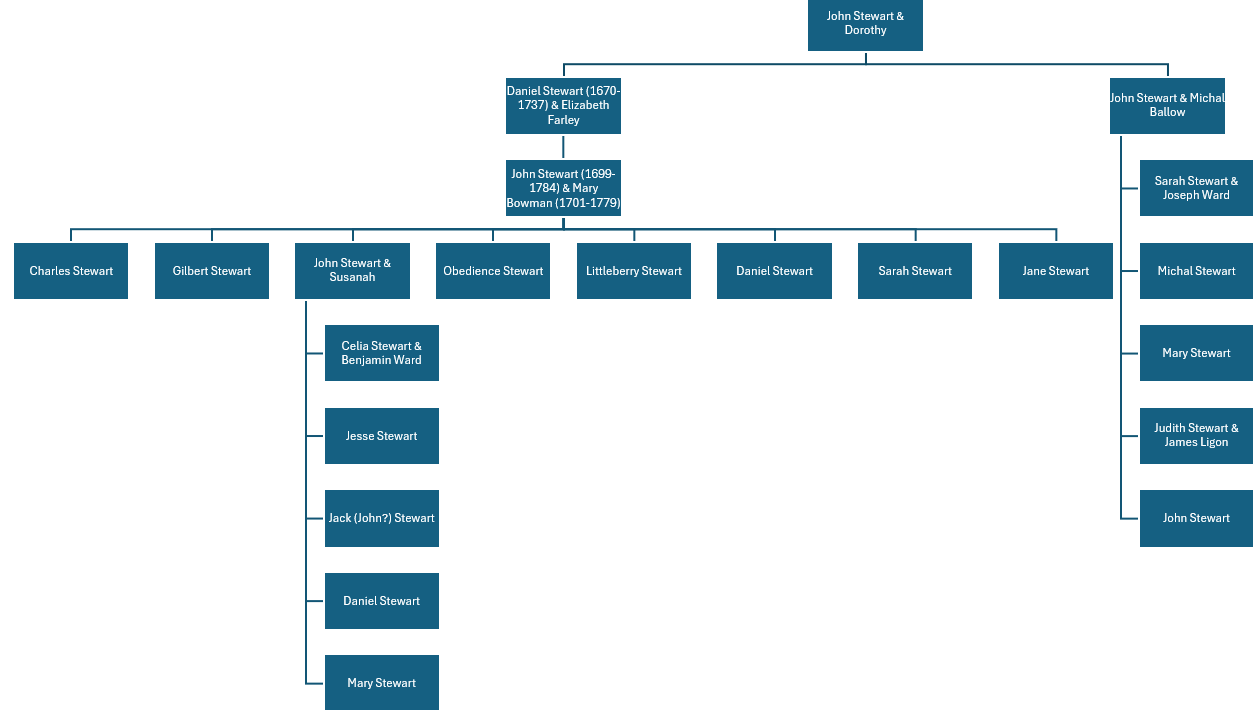
This post delves into the lineage of John Stewart (1634–1706) of Ashen Swamp, focusing on his son Daniel Stewart (1670–1737), who married Elizabeth Farley, and their son John Stewart (1699–1784), who married Mary Bowman. This post aims to clarify misconceptions about this line, distinct from the Fighting Creek/Amherst Stewarts, and build on a prior post focused on another son of John Stewart (1634–1706), John Stewart (1658–1714), who married Michal Ballow.
Surnames Associated with the Ashen Swamp Line
The Ashen Swamp Stewarts are closely associated with several prominent surnames, including Farley, Walthall, Ward, Ligon, Bowman, and Ballow. When these names appear in historical documents alongside a Stewart, it often indicates a connection to the Ashen Swamp line.
The Family Tree of John Stewart of Ashen Swamp
Early Generations
Daniel Stewart (1670–1737): Daniel continued the family legacy in Virginia, marrying Elizabeth Farley. Their son, John Stewart (1699–1784), became a significant figure in the next generation of Stewarts.
John Stewart (1634–1706) of Ashen Swamp: The founder of this line in Virginia, he settled in Henrico County. He had several children, including Daniel Stewart and John Stewart (who married Michal Ballow).

John Stewart (1699–1784) and Land Transactions
John Stewart (1699–1784), son of Daniel Stewart, lived in Henrico and later in Amelia County, where he acquired and managed substantial landholdings. His activities are documented through various transactions:
- On January 30, 1745/6, John Stewart purchased 188 acres in Amelia County from Joseph Jackson as a resident of Dale Parish, Henrico County.
- On August 18, 1750, he acquired an additional 300 acres in Amelia County from Field Jefferson of Lunenburg County. By 1763, he deeded this tract to his son, Charles Stewart.
- On October 30, 1762, John Stewart and his wife, Mary, deeded 180 acres on West Creek to Peter Dupuy Jr., demonstrating his ongoing activity and land management in Amelia County.
These records highlight John Stewart’s role as a prominent landowner in colonial Virginia, and his efforts to ensure that land remained within the Stewart family.

The Will of John Stewart (1699–1784)
John Stewart’s will, dated January 13, 1777, provides critical details about his family:
- The will names his wife, Mary Stewart, and their children:
- John Stewart, the eldest son
- Charles Stewart
- Daniel Stewart
- Littleberry Stewart, the youngest son
- Obedience Stewart
- Sarah Stewart
- Jane Stewart
- He appointed his friend, Daniel Farley, and his son, Charles Stewart, as executors. Witnesses to the will included Joseph Jennings, Samuel Thompson, and John Howson. The will was probated in 1779, underscoring the family’s ongoing ties to Amelia County.
The 1774 Letter from John Stewart to His Father
One of the most revealing pieces of evidence about this line comes from a letter dated May 6, 1774, written by John Stewart of Pittsylvania County to his father, John Stewart (1699–1784):
“Dear Father, John Davis brought your letter today and I write to tell you how pleased I am to hear from you as well as to share a few lines about your family here in Pittsylvania. Susannah, as you know from brother John Kelly, was very sickly and has been slow to mend. She is a good and dutiful wife, and I must confess my fear was that she might never be any better. As for the children, our Celia has taken to herself a husband since I wrote you, Mr. Benjamin Ward. They stay with his brother Daniel Ward but talk much of going to Carolina. Jack tends to run wild, much to the worry of his mother, and this does not help to better her poor state of health. Dan now stands as tall as brother Berry and is a favorite with the ladies. He is a fine son and in his conduct is much like brother Charles. Our Mary is a great comfort. Never was a girl more properly named for Mother, being a most sensible girl and, since Susannah’s illness, has taken charge of her mother’s duties. It has been near five years since our Jesse left us, and never is the day we do not think of our dear boy, lost at such a tender age. As for myself, I am in perfect health. I close with our respects to you and Mother and all the family. May God keep and bless you all. Your son, John Stewart, Pittsylvania County, Virginia.”
This letter confirms the existence and activities of John Stewart (1699–1784)’s children in Pittsylvania County and offers a personal glimpse into the challenges faced by the family. It also underscores the distinction between the Ashen Swamp line and the Fighting Creek/Amherst line, reinforcing that John Stewart of Ashen Swamp and his descendants had different origins and trajectories.
Distinguishing the Ashen Swamp and Fighting Creek/Amherst Lines
The differences between the Ashen Swamp and Fighting Creek/Amherst Stewarts are clear:
- The Ashen Swamp line descends from John Stewart (1634–1706) through Daniel Stewart (1670–1737) and includes land transactions, wills, and personal letters centered in Henrico and Amelia counties.
- The Fighting Creek/Amherst line, by contrast, traces back to John Stewart Sr., who settled in Henrico County around 1720 and later moved to Cumberland (Amherst) County.
By examining these specific records and personal correspondences, we can better understand the distinct lineage of John Stewart of Ashen Swamp and prevent further confusion with other Stewart branches in colonial Virginia.
Conclusion: Clarifying the Ashen Swamp Line
The story of John Stewart of Ashen Swamp, especially through his son Daniel Stewart and grandson John Stewart, offers a detailed look into the landholding and familial ties of early Virginia. This line, clearly separate from the Fighting Creek/Amherst Stewarts, illustrates the complexities of genealogical research and the importance of precise documentation.
By focusing on this branch, we ensure the accurate representation of John Stewart (1634–1706) and his descendants, providing a clearer picture of their legacy in colonial Virginia.


Leave a Reply