Adventures in Kentucky: Unraveling the Mystery of John Stewart’s Land
In a previous post, I delved into the life of John Stewart of Amherst County (also known as John Stewart Jr.), specifically through the lens of his 1784 will. In it, John Stewart made a rather intriguing bequest to his son, John Stewart III, which has since piqued my curiosity:
I give to my son John Stewart Three thousand seven hundred & fifty acres of land lying & being in Kentucky…
Such a vast tract of land raises several questions. How did John Stewart come to possess 3,750 acres in Kentucky? Tracing the origins of this land might provide significant clues about John’s life and his connections, potentially even shedding light on where he came from.
I’ve narrowed it down to three possible scenarios for how he may have acquired this land:
- He purchased the land.
- He inherited the land.
- He was granted the land for military service.
Let’s take a closer look at each of these possibilities.
Scenario 1: A Land Purchase?
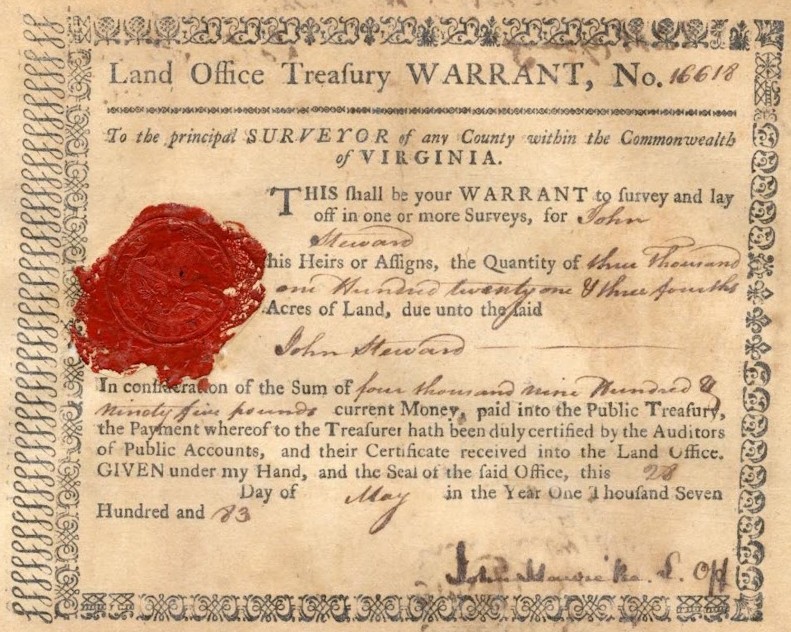
There is a record from May 28, 1783, of a John Stewart purchasing a warrant to survey 3,121.75 acres in Kentucky for a hefty sum of 4,995 pounds. A warrant to survey land was essentially a promise from the government, with the land officially transferring after the survey was completed. What’s particularly noteworthy is that John assigned half of this warrant to Richard Young, leaving him with about 1,561 acres.

Adjusting for inflation, John Stewart Jr.’s half of the warrant would be equivalent to approximately $606,000 today, which is a considerable amount of money. This raises an important question: If John Stewart Jr. had that kind of wealth, where did it come from?
The land was eventually surveyed on May 6, 1787, in Bourbon County along the Big Sandy River. The survey included boundary lines shared with Richard Young and John Weaglesworth, with Young holding an additional 5,000 acres nearby. However, this leaves us with a conundrum: John Stewart’s will mentions 3,750 acres, but his half of this warrant only accounted for 1,561 acres. Where did the remaining 2,189 acres come from? Could there be additional land warrants that have yet to be uncovered?

Scenario 2: An Inheritance?
Another potential lead is a William Stewart, who was granted 2,520 acres in Kentucky. This land went to his heirs, and it was surveyed between 1785 and 1798, though the grant itself could have been made earlier. Could John Stewart have inherited some of this land?
If John were one of William Stewart’s heirs, it would challenge the family tradition that John Stewart Jr.’s father was also named John. While this is an interesting avenue to explore, the acreage still doesn’t add up to the 3,750 acres mentioned in John’s will, which leaves this scenario with unresolved questions as well.
Scenario 3: A Military Land Grant?
Kentucky was known for granting large parcels of land to veterans of the French and Indian War, particularly to those who had achieved the rank of captain or higher. However, there is no documented evidence of a Captain John Stewart in the Virginia regiment. There was a Captain Robert Stewart, whose service was well documented, but he had no family in Virginia and returned to England after the war.
There is a record of a John Stewart petitioning the Virginia House of Burgesses in 1756 for compensation due to injuries sustained during the Battle of Monongahela in 1755. He was granted 20 pounds, but this is a relatively small sum for an officer, and there’s no mention of him holding a rank higher than that of a soldier.
Additionally, a John Stewart served under Captain Vanbraam at the Battle of Fort Necessity in 1754, which could tie him to a Kentucky land grant from 1772 called the Savage Grant. However, most of the soldiers who received land under this grant were only given 600 acres, and there is no mention of a John Stewart in this documentation. Interestingly, this grant was also along the Big Sandy River, the same location as the land mentioned in Scenario 1.
Family Connections to John Floyd?
One of the most compelling aspects of John Stewart’s story is his family’s connection to the Floyd family. John Stewart III married Mourning Burford Floyd, and his sister, Ann Haw Stewart (my ancestor), married Mourning’s brother, John Burford Floyd. Both were children of John Floyd, a prominent surveyor in Kentucky and a colonel during the French and Indian War.
Given that John Stewart Jr. left his Kentucky land to John Stewart III, rather than his eldest son Charles, there could be a deeper connection between the Stewart and Floyd families. Could it be that this land was somehow tied to John Floyd and was left to John Stewart III because of his marriage to Floyd’s daughter, Mourning? It’s an intriguing possibility, especially considering that John Stewart III married Mourning Burford Floyd on April 13, 1784—just one day before John Stewart Jr. wrote his will.
John Floyd’s role as a surveyor and his influence in Kentucky deserves further exploration, and I plan to dedicate a future post to unraveling his story.
Which Scenario is the Most Plausible?
While I’m leaning towards Scenario 1—that John Stewart purchased at least some of this land—the mystery remains unsolved. The various land transactions, military records, and family connections make for a complex and fascinating puzzle. What do you think? Is there another possibility I haven’t considered?
For now, I’ll continue my search, hoping to find the missing pieces that connect John Stewart of Amherst County to his adventures in Kentucky.
Leave a Reply